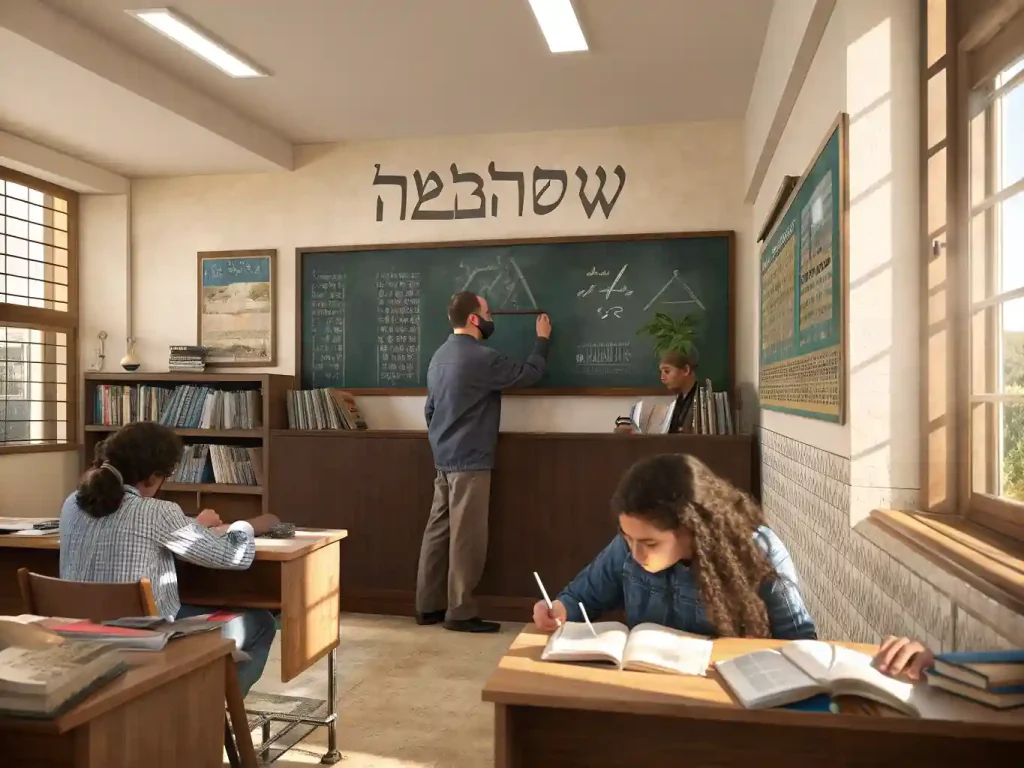
A language can sleep without dying. It can disappear from kitchens, markets, jokes, arguments, lullabies, and children’s games, yet remain alive in prayers, books, memory, and the imagination of a people. Hebrew is one of the rare examples in world history where such a language returned not only to speech, but to daily life. Modern Hebrew is heard in schools, courts, cafés, army bases, hospitals, music, films, political debates, and family homes. It is the language of a modern state, but its roots reach deep into the ancient world.
The story is often told as a miracle, but it was also a human project: planned, argued over, resisted, improvised, and carried forward by teachers, parents, writers, immigrants, and institutions. The revival of Hebrew was not simply a decision to use an old language again. It was a cultural choice about identity, continuity, independence, and the future of Jewish life in the land of Israel.
Ancient roots and the meaning of yehudit
The word “Yehudit” is often connected with the old name for the language of Judah, the southern kingdom associated with Jerusalem and the biblical tradition. In the Hebrew Bible, related forms appear in moments when language marks belonging. To speak the language of Judah was not only to use certain words or sounds; it meant being part of a people shaped by a shared land, worship, law, memory, and political history.
Ancient Hebrew developed in the wider family of Northwest Semitic languages, alongside languages such as Phoenician, Moabite, and Aramaic. It was not born in isolation. Like every living language, it absorbed influence, changed across regions, and carried traces of contact with neighboring peoples. Biblical Hebrew itself was not one frozen form. The Hebrew of early poetry, later prose, prophetic speech, legal passages, and post-exilic writings shows movement over time. A language that later generations imagined as sacred had once been practical, flexible, and ordinary.
That ordinary quality matters. Ancient Hebrew was not created as a museum object. It served farmers, priests, kings, traders, scribes, soldiers, parents, and children. It named fields and animals, laws and festivals, grief and desire, rebellion and faith. It was capable of poetry, but also of daily instruction. This made its later revival possible in a deeper sense. Modern Hebrew did not have to invent the idea that Hebrew could describe life. It had to recover and expand that ability for a new age.
After the destruction of the First Temple, the Babylonian exile, Persian rule, Hellenistic influence, Roman power, and later dispersion, Hebrew gradually lost its role as the main spoken language for most Jews. Aramaic became dominant in many Jewish communities of the ancient Near East. Greek, Arabic, Ladino, Yiddish, Judeo-Persian, Judeo-Arabic, and many other Jewish languages later became the everyday tongues of communities spread across continents. Hebrew remained central, but its center shifted. It became the language of scripture, prayer, legal discussion, poetry, correspondence, scholarship, and collective memory.
This shift did not make Hebrew irrelevant. On the contrary, it protected the language across centuries. Jews who did not speak Hebrew at home still learned Hebrew letters, heard Hebrew prayers, recited biblical passages, studied rabbinic texts, and used Hebrew phrases in religious and intellectual life. The language no longer belonged to one street or one province. It belonged to a dispersed civilization.
That is why calling modern Hebrew a “revived” language is both accurate and incomplete. Hebrew had not vanished in the way many extinct languages vanish. It had lost the broad, natural ecosystem of a mother tongue, but it survived through institutions of memory: the synagogue, the schoolroom, the manuscript, the printed book, the commentary, the blessing, the wedding contract, the cemetery inscription. It lived differently, waiting for conditions that could make it spoken again.
From sacred language to spoken language
For many centuries, Hebrew occupied a special place in Jewish life precisely because it was not an ordinary everyday language. Its distance from daily speech gave it authority. It connected Jews in Morocco, Poland, Yemen, Lithuania, Iraq, Germany, and the Ottoman Empire through a shared textual world, even when they could not easily understand one another’s spoken languages. A Jew from one region might speak Yiddish, another Arabic, another Ladino, but both could recognize Hebrew prayer and scripture.
This made Hebrew powerful, but it also created tension when people began to imagine it as a modern spoken language. Some religious Jews objected to turning the holy tongue into the language of shopping, street signs, newspapers, political slogans, and childhood quarrels. For them, using Hebrew for ordinary speech risked lowering its sacred status. The language of prayer was not supposed to become the language of bargaining over vegetables.
Yet other Jews saw the same sacred inheritance as the strongest reason to bring Hebrew back into daily use. If Jewish national life was to be renewed in the ancestral land, they argued, it could not rely entirely on the languages of exile. Yiddish carried the history of Ashkenazi Europe. Ladino carried the memory of Sephardic communities after Spain. Arabic connected Jews of the Middle East and North Africa to their surrounding cultures. Russian, German, Polish, French, English, and other languages opened doors to modern education and politics. But none could serve as a common national language with the symbolic weight of Hebrew.
The practical problem was enormous. Jews arriving in Ottoman and later Mandatory Palestine came from different linguistic worlds. A common language was necessary for schools, work, politics, defense, administration, and social life. Choosing one immigrant language would have privileged one community over others. Hebrew, though not the natural mother tongue of most immigrants, offered a shared inheritance that no single diaspora group fully owned.
This choice also changed the emotional meaning of the language. Hebrew moved from being mainly a language of return in prayer to a language of return in reality. Words once associated with ancient landscapes were placed back onto roads, tools, plants, weather, labor, and public life. Children learned to ask for food in Hebrew, argue in Hebrew, tease one another in Hebrew, and dream in Hebrew. That was the turning point. A revived language becomes secure when it belongs to children before it belongs to scholars.
The transformation required courage because Hebrew lacked many modern words. It had ancient terms for kings, sacrifices, harvests, family law, and ritual purity, but it needed vocabulary for trains, electricity, newspapers, factories, medicine, bureaucracy, sports, chemistry, telephones, and later radio, cinema, computers, and the internet. Some words could be drawn from biblical or rabbinic roots. Others had to be adapted, coined, or borrowed. The result was not a simple restoration of biblical speech. It was a new language built from old materials.
The people who made Hebrew practical
The revival of Hebrew is often associated with Eliezer Ben-Yehuda, and his role was genuinely important. He believed that Jewish national renewal required Hebrew as a spoken language, not merely as a literary or religious one. He raised his son in Hebrew, worked on dictionaries, promoted new words, and pushed the idea that Hebrew could become the language of homes, schools, newspapers, and public life. His determination turned an intellectual dream into a social campaign.
Still, the revival cannot be reduced to one man. A language returns through communities, not slogans. Teachers were among the central figures. They had to teach children in Hebrew even when textbooks were lacking and even when they themselves were still learning how to speak it naturally. Writers and journalists created rhythm, style, and public vocabulary. Parents made difficult choices at home, sometimes giving up the languages in which they themselves felt most emotionally fluent so their children could grow into Hebrew.
Schools were especially decisive. A language used only by idealists remains fragile. A language used as the medium of education begins to produce citizens. Hebrew schools created children who did not treat Hebrew as an ancient code but as the normal language of arithmetic, geography, discipline, friendship, and ambition. Once children used Hebrew with one another outside the classroom, the project changed from planned revival to social reality.
The process also involved conflict. One famous struggle was the “language war” in the early twentieth century over whether German or Hebrew should be used as the language of instruction in technical education. German had prestige in science and engineering. Hebrew had symbolic force but seemed less prepared for modern technical subjects. Supporters of Hebrew argued that a national society could not be built if its highest forms of knowledge were taught in another language. The victory of Hebrew in education showed that the language revival was not only cultural; it was political.
The following comparison shows why the choice of Hebrew was so unusual and why it succeeded despite obvious difficulties.
| Language option | Strengths for Jewish communities | Main limitation in the land of Israel | Historical result |
|---|---|---|---|
| Hebrew | Shared religious and historical prestige across Jewish communities | Needed modernization and everyday fluency | Became the national spoken language. |
| Yiddish | Rich daily culture, literature, humor, and mass use among Ashkenazi Jews | Strongly linked to one diaspora group and European experience | Remained important but did not become the state language. |
| Ladino | Deep Sephardic heritage and strong communal identity | Limited to particular communities and regions | Preserved as heritage, not as the common national tongue. |
| Arabic | Regional relevance and long Jewish use in Middle Eastern communities | Politically and communally complex in a Jewish national project | Continued among Arab citizens and some Jewish communities, but not as the central Jewish national language. |
| German, Russian, Polish, French, English | Access to modern education, diplomacy, science, and migration networks | Each reflected external power, class, or diaspora origin | Influenced Hebrew vocabulary and culture but did not replace it. |
The table reveals the core logic of the revival. Hebrew was not the easiest choice, but it was the only choice that could be presented as both ancient and new, shared and neutral, sacred and national. Its weakness was practical; its strength was historical. The revival succeeded because people accepted the burden of solving the practical problems in order to gain the symbolic power.
Another reason Hebrew succeeded was that it became tied to action. It was not promoted only in essays. It was printed on signs, taught in schools, shouted at meetings, sung in songs, used in farms and workshops, and spoken by children. Language planning helped, but daily repetition mattered more. A word becomes real when people need it.
Why a new state needed an old language
The creation of modern Israel turned the Hebrew revival from a cultural movement into a state reality. A state needs a language for law, taxation, education, military command, public health, elections, courts, transportation, and broadcasting. Without a common language, institutions become fragmented and citizens remain divided into separate linguistic islands.
Hebrew gave the new society a shared public space. Immigrants arrived from Europe, North Africa, the Middle East, Asia, and later from the former Soviet Union, Ethiopia, and many other places. They brought different accents, memories, foods, customs, and family languages. Hebrew did not erase these differences, though state policy often pushed immigrants strongly toward linguistic assimilation. It gave people a common tool for building civic life.
The choice of Hebrew also carried emotional force after centuries of dispersion and, later, after the destruction of European Jewry in the Holocaust. For many, speaking Hebrew in Israel meant refusing to let Jewish identity remain defined only by exile, persecution, or minority status. It turned memory into agency. The language of ancient texts became the language of soldiers defending borders, farmers working fields, scientists building universities, and children growing up in neighborhoods where Hebrew was no longer exceptional.
This did not mean that the revival was gentle for everyone. Immigrants often felt pressure to abandon mother tongues. Yiddish, in particular, was sometimes treated with suspicion because it was associated by some Zionists with diaspora weakness, even though it carried one of the richest Jewish literary cultures in history. Jews from Arab and Muslim lands also faced pressure to fit into a Hebrew-speaking national mold that did not always respect their linguistic and cultural inheritance. The success of Hebrew came with cultural costs.
A mature view of the revival must hold both truths. Hebrew created unity where fragmentation could have overwhelmed the young state. It also participated in a policy of nation-building that sometimes flattened diversity. Today, Israeli culture is more willing to recognize the value of languages once pushed aside. Yiddish theater, Ladino songs, Judeo-Arabic traditions, Russian-language media, Amharic-speaking communities, Arabic public life, and English influence all remain part of the country’s linguistic reality.
Hebrew, however, remains the center of public Jewish Israeli life because it provides a shared frame for difference. A Moroccan Jewish family, a Russian-speaking immigrant family, an Ethiopian Israeli family, and a secular family from Tel Aviv may have very different histories, but their children can meet in Hebrew at school, in the army, at university, in music, and online. The language does not make society simple. It makes society speakable.
Several forces made Hebrew especially suitable for this role:
• It belonged to Jewish memory before it belonged to any one modern immigrant group.
• It connected the new society to the geography, names, and stories of the land.
• It allowed schools to create a shared generation of native speakers.
• It gave national institutions a language that felt independent rather than borrowed.
• It could absorb words from many languages while keeping a recognizable Semitic structure.
These forces explain why the revival was more than nostalgia. Hebrew gave the modern state a way to speak in its own voice. The language did not merely decorate national identity; it helped produce it.
How modern Hebrew differs from biblical Hebrew
Modern Hebrew is not biblical Hebrew spoken with updated clothing. It is a living language shaped by ancient sources, rabbinic literature, medieval writing, European languages, Arabic surroundings, immigrant speech, and modern global culture. A speaker of biblical Hebrew transported into present-day Tel Aviv would recognize many roots and patterns, but would also be confused by pronunciation, syntax, slang, speed, and modern vocabulary.
Biblical Hebrew often uses structures and word orders that sound poetic, formal, or archaic to modern ears. Modern Hebrew has a more regularized everyday grammar in many areas. It uses ancient roots to form new words, but it also borrows freely. Some modern expressions reflect influence from Russian, Yiddish, German, English, Arabic, and other languages. This is not a failure of purity. It is what living languages do.
Pronunciation also changed. Modern Hebrew pronunciation was influenced by Sephardic Hebrew traditions, but it simplified several older distinctions. Some consonants that were once pronounced differently merged in common speech. The modern Israeli “r” often differs from older Middle Eastern pronunciations. Stress patterns, vowels, and casual speech continue to evolve. A language revived by people from many backgrounds naturally carries traces of many mouths.
The tension between ancient depth and modern use gives Hebrew much of its character. A modern Israeli child may use a biblical root without knowing its ancient resonance. A poet can activate layers of scripture with a single word. A politician can use biblical phrasing to create authority. A comedian can turn sacred echoes into street humor. Hebrew allows these shifts because its history remains audible.
New words are often built through the root-and-pattern system typical of Semitic languages. This gives modern coinages a native feel even when they describe new realities. A word for a modern object can be created from an old root associated with seeing, writing, connecting, calculating, or moving. The result is a language that can modernize without completely losing its inner architecture.
At the same time, English has become a major influence, especially in technology, business, academia, entertainment, and youth culture. Israelis may move between Hebrew and English terms with ease, sometimes adapting English words into Hebrew grammar. This creates debates about purity, but such debates are normal in strong languages. A weak language fears every foreign word. A strong language absorbs, reshapes, and decides what to keep.
Modern Hebrew therefore stands between restoration and invention. It did not return exactly as it was, because no language can return unchanged after two thousand years of altered life. It returned as a new native language with an ancient memory. That is why it feels both old and young.
Identity, memory, and the future of Hebrew
The revival of Hebrew remains one of the most remarkable linguistic events in modern history because it joined private life with collective purpose. It required adults to speak imperfectly so their children could speak naturally. It required scholars to become activists, teachers to become inventors, and families to turn ideology into bedtime language. It required people to accept embarrassment, mistakes, and artificiality until speech became effortless.
Its success also raises a larger question: why do people fight so hard for a language? The answer is that language is never only communication. It carries memory, authority, humor, grief, social status, and belonging. To change the language of a people is to change the way they imagine themselves. Israel brought Hebrew back from the past because the Zionist project needed more than territory and institutions. It needed a voice that could make ancient memory usable in modern life.
Yet the future of Hebrew depends not on reverence alone. A language survives when it remains useful, creative, and emotionally alive. Hebrew today is not protected mainly by dictionaries or academies. It is protected by novels, songs, schoolyards, television, religious study, military slang, legal argument, family life, social media, and the ordinary laziness and brilliance of native speakers. People bend it, shorten it, joke with it, argue in it, and sometimes misuse it. That is what proves it lives.
The relationship between Hebrew and other languages in Israel will continue to matter. Arabic has deep roots in the land and is central to the lives of Arab citizens of Israel and Palestinians. English carries global power. Russian, French, Amharic, Spanish, Yiddish, Ladino, and many other languages remain part of family and cultural life. Hebrew’s strength should not require hostility toward them. A confident national language can share space with heritage languages and minority languages without feeling threatened.
The return of Hebrew also offers a lesson beyond Israel. Languages can be weakened by politics, exile, shame, empire, or modernization, but they can also be renewed when communities decide that speech is part of dignity. Not every language can follow the Hebrew model, and not every revival has the same conditions. Hebrew had sacred prestige, written continuity, a nationalist movement, schools, immigration, and eventually state power. Those factors made its path unusual. Still, its story shows that language is not only inherited. It can be chosen, rebuilt, and loved into daily use.
Hebrew came back because it gave modern Jewish life a bridge between memory and sovereignty. It allowed an ancient people to speak as a modern society without cutting itself off from its past. The language of Yehudit did not simply return from history. It was carried forward, reshaped, and handed to children until it became normal again. That normality is the real wonder: not that Hebrew can be studied in old texts, but that it can be used to order coffee, comfort a child, write a law, tell a joke, fall in love, and argue about the future.
Conclusion
The revival of Hebrew was not a simple return to an ancient language. It was a rare meeting of memory, politics, education, family life, and national need. Yehudit, the language associated with Judah and the old world of Hebrew speech, became part of a much larger story: the transformation of a sacred and literary language into the daily language of a modern country.
Israel brought Hebrew back from the past because no other language could carry the same combination of shared inheritance, historical depth, and national possibility. The project demanded invention, discipline, and sacrifice, but it gave Jewish society in Israel something more powerful than a tool of communication. It gave it a voice rooted in antiquity and open to the future.