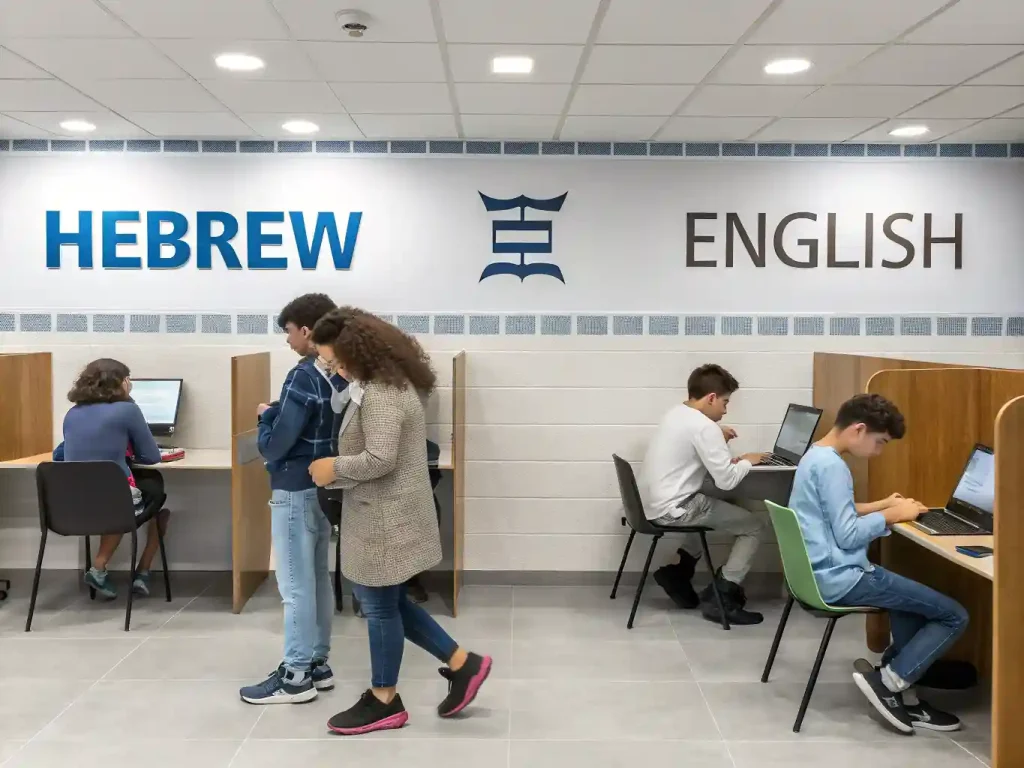
Hebrew in Israel has always lived between preservation and reinvention. It is the language of state institutions, schoolyards, army bases, literature, television, prayer, messaging apps, start-up offices, family arguments and street signs. Its modern form was built with rare speed, turning a language of memory, study and ritual into the everyday language of a modern society. That achievement is still one of the most unusual cultural projects of the last two centuries.
Yet Hebrew is not protected from pressure. English surrounds it through technology, business, entertainment, science and global culture. Artificial intelligence adds a new force: it does not only bring new words into Hebrew but also changes how people write, translate, search, learn and speak. The future of Hebrew will not be decided by a simple fight between “pure Hebrew” and “foreign influence.” It will be shaped by daily choices: what people say at work, what children type into chatbots, what teachers accept in essays, what companies put into interfaces and what machines learn from Israeli speech.
Hebrew as a living national language
Modern Hebrew is not fragile in the usual sense. It has deep institutional support, a strong education system, a large body of literature, a powerful symbolic role and millions of native speakers. In Israel, Hebrew is not a ceremonial language kept alive by nostalgia; it is the default language of bureaucracy, media, law, schooling and most public life. That gives it a level of security many smaller languages do not have.
At the same time, Hebrew is young as a native spoken language. The Hebrew of Tel Aviv cafés, Jerusalem buses and Haifa classrooms is not identical to the Hebrew of biblical texts, rabbinic literature or early Zionist newspapers. It has absorbed speech habits from Yiddish, Arabic, Russian, English, French, German and many other languages brought by Jewish communities and shaped by regional contact. Its strength has always come from adaptation, not from isolation.
That history matters because current anxiety about English often treats change as decline. A more accurate view is that Hebrew has always changed under pressure. The question is not whether Hebrew will borrow words, simplify forms or produce new slang. It certainly will. The real question is whether Hebrew will continue to create its own registers for science, humor, law, childhood, intimacy, public debate and digital life.
A language survives with depth when it can do many jobs. Hebrew can already carry philosophy, street sarcasm, military slang, religious interpretation, legal precision, children’s songs and high-tech marketing. The challenge ahead is to make sure it also remains fully capable in artificial intelligence, advanced research, software interfaces and global professional communication. If Hebrew becomes only the language of home and politics while English dominates innovation and knowledge, its cultural range could narrow. If Hebrew develops strong tools and confident usage in new fields, pressure from English may enrich it rather than weaken it.
English pressure in work, media and technology
English has special prestige in Israel because it is tied to opportunity. It opens doors in academia, international business, tourism, programming, medicine, finance and pop culture. In the Israeli tech sector, English is often not just a foreign language but a working environment. Product meetings may move between Hebrew and English within the same sentence. Job titles, software commands, investor language and marketing language often arrive ready-made in English.
This creates a mixed professional Hebrew that is practical but sometimes unstable. People say they need to “push” a feature, “sync” with a team, “close” a task, “debug” a problem or “launch” a campaign. Some of these forms become naturalized into Hebrew grammar and pronunciation. Others remain awkward markers of professional identity. The line between useful borrowing and lazy substitution is not fixed; it changes by generation, workplace and social group.
Media strengthens this process. Israeli audiences watch English-language series, follow global influencers, use English memes and absorb American cultural phrases through platforms that move faster than formal language planning. Young speakers may use English words because they feel shorter, cooler or more emotionally precise for a particular mood. Sometimes English gives distance; sometimes Hebrew gives intimacy. A teenager may text a Hebrew sentence with an English punchline because the emotional tone feels different.
This does not mean Hebrew is being replaced. In many situations, English words are pulled into Hebrew rather than pushing Hebrew out. They receive Hebrew endings, Hebrew rhythm and Hebrew syntax. The borrowed word becomes local. This is one reason language purism often fails: people do not experience every foreign word as foreign once it behaves like part of their own speech.
Still, there is a real risk in professional domains. When whole areas of knowledge are discussed mainly in English, Hebrew can lose precision in those areas. If engineers, doctors, economists or AI researchers lack comfortable Hebrew terms for their daily work, public discussion becomes poorer. Citizens then depend on experts who translate ideas loosely or not at all. A healthy democratic language needs more than slang and emotion; it needs exact words for complex realities.
The pressure from English is not uniform across Israeli society. It is strongest among educated urban professionals, academic circles, technology workers and globally connected youth. It is weaker in communities where Hebrew, Arabic, Russian, Amharic, Yiddish or other languages carry different social meanings. The future of Hebrew will therefore not be one single path. Israel may see several Hebrew styles developing side by side: a globalized professional Hebrew, a local spoken Hebrew rich in slang, a formal public Hebrew, a religious-textual Hebrew and digital hybrids shaped by platforms.
How AI changes Hebrew from the inside
Artificial intelligence affects Hebrew differently from previous technologies. Television and the internet spread foreign words. AI systems generate language directly. They suggest sentences, correct grammar, translate documents, summarize meetings, write school assignments, create customer-service replies and answer questions in a tone that may become familiar to millions of users. When a tool writes for people every day, it becomes a quiet language teacher.
For Hebrew, this brings both promise and danger. The promise is access. Better Hebrew AI tools can help students write more clearly, assist immigrants learning the language, support people with dyslexia, improve speech recognition, make public services easier to use and allow small businesses to create professional Hebrew content without hiring large teams. Strong Hebrew models can also support research, education and culture by handling Hebrew as Hebrew, not as a difficult afterthought to English.
The danger is flattening. Many large AI systems have been trained far more deeply in English than in Hebrew. When such systems produce Hebrew, they may imitate English sentence structure, choose unnatural phrasing, miss cultural nuance or create a polished but slightly foreign style. The result can look correct but feel empty. It may be grammatical enough to pass, yet not alive enough to sound Israeli.
This is especially important because Hebrew is compact, root-based and rich in implied information. Gender, number, tense, definiteness and prepositions often behave differently from English. A literal translation can damage tone and meaning even when every word seems right. AI that does not understand Hebrew deeply may over-explain, use stiff formulations or avoid the playful compression that makes spoken Hebrew energetic.
The development of Hebrew-specialized language models and Hebrew benchmarks is therefore more than a technical project. It is a cultural necessity. A language needs machines that understand its morphology, idioms, historical layers and social registers. It also needs datasets that include real Hebrew from many places: schools, literature, public institutions, journalism, religious writing, social media, legal documents, spoken transcripts and professional communication. Without that range, AI will normalize a narrow, artificial version of Hebrew.
AI may also change how Hebrew learners think. New immigrants can use chatbots to practice conversations, ask for explanations of slang, compare formal and informal expressions and receive instant correction. Children may grow up treating AI as a writing partner. This could improve literacy if the tools are good and teachers know how to use them. It could weaken expression if students outsource every difficult sentence and never develop a personal Hebrew voice.
The most important shift is that language authority becomes distributed. In the past, teachers, editors, broadcasters and official language bodies had strong influence over “good Hebrew.” Now autocomplete, translation engines and chatbots also shape what feels normal. Their suggestions may be accepted simply because they appear quickly and confidently. If these systems favor English-like Hebrew, that style may spread without anyone formally choosing it.
Where change will be most visible
The future of Hebrew will not arrive as a dramatic break. It will appear in small habits that gradually become ordinary. The strongest changes are likely to happen where speed, prestige and technology meet: messaging, education, work, interfaces and public communication.
Before looking at these areas, it is useful to separate several kinds of change. Some changes affect vocabulary. Others affect sentence structure, tone, spelling, pronunciation or the social meaning of different registers. English and AI do not pressure all layers equally.
| Area of Hebrew use | Main pressure | Likely change | Main risk | Main opportunity |
|---|---|---|---|---|
| Technology and business | English terminology and global workflows | More borrowed verbs, job titles and hybrid phrases | Loss of precise Hebrew professional vocabulary | Faster participation in global work while creating local terms where needed |
| Education | AI writing tools and machine translation | More polished student texts, less visible struggle with writing | Weaker independent writing skills and copied machine style | Personalized Hebrew practice and support for learners |
| Public services | Automated chatbots and translation | Simpler digital Hebrew in forms, help centers and instructions | Stiff, generic language that excludes weaker readers | Clearer access to government, health and legal information |
| Media and entertainment | Global platforms and English content | More code-switching, memes and English emotional markers | Narrower Hebrew cultural vocabulary among young audiences | New creative slang and flexible bilingual expression |
| Literature and journalism | AI-assisted drafting and editing | Faster production and more standardized prose | Repetition, bland rhythm and loss of authorial voice | Better research support, editing and accessibility |
| Speech technology | Voice assistants and transcription | More interaction with spoken Hebrew interfaces | Poor handling of accents, dialects and noisy speech | Inclusion for drivers, elderly users and people with disabilities |
The pattern is clear: the same force can strengthen or weaken Hebrew depending on how it is used. English borrowing can make Hebrew flexible, but it can also create dependence. AI correction can improve clarity, but it can also erase personality. Translation can widen access, but it can also spread unnatural phrasing at scale.
This is why the future of Hebrew should not be discussed only in emotional terms. Love for the language matters, but infrastructure matters too. Hebrew needs good corpora, high-quality educational tools, speech datasets, professional terminology, careful editors, teachers trained for AI-era writing and public institutions that treat clear Hebrew as a service to citizens.
The role of institutions, schools and everyday speakers
The Academy of the Hebrew Language has a unique role, but it cannot control spoken Hebrew by command. Its strongest contribution is not forcing people to abandon every loanword; it is giving Hebrew credible options. When a Hebrew term is elegant, short and useful, people may adopt it. When it feels heavy or artificial, English often wins. The public decides through use.
A mature language policy should recognize that not every English word needs to be fought. Some loanwords become part of Hebrew naturally. Others remain unnecessary status symbols. The more practical task is to identify which fields need Hebrew vocabulary for public understanding. Medicine, law, finance, artificial intelligence, climate policy and education cannot rely only on imported terms if they are to be discussed by the whole society.
Schools are central because they shape confidence. Students should not be taught that living Hebrew is “bad Hebrew” simply because it changes. They should learn registers: how to speak casually, how to write clearly, how to argue in formal language, how to recognize manipulative wording, how to translate ideas without copying English structure and how to use AI without surrendering judgment. The goal is not to freeze Hebrew but to give speakers control over their choices.
There are several practical habits that can protect Hebrew’s depth without turning language into a museum:
- Encourage students to compare AI-generated Hebrew with natural Hebrew written by skilled human authors.
- Teach professional Hebrew terms alongside English terms in science, technology and economics.
- Reward clear public language in government, health care and banking.
- Support Hebrew speech tools that recognize different accents and social varieties.
- Treat slang and spoken creativity as material for learning, not as a threat by default.
- Build children’s digital content in rich Hebrew rather than relying only on translated interfaces.
Everyday speakers also matter. A language is not maintained only by official decisions. It lives because parents read to children, journalists avoid lazy translation, engineers bother to explain a concept in Hebrew, comedians create local punchlines, musicians make new phrases memorable and friends choose the word that feels exact rather than prestigious.
The strongest Hebrew of the future will likely be confidently bilingual without being submissive. Israelis will continue to know English, use English and borrow from English. That is not a problem by itself. The problem begins when speakers stop expecting Hebrew to be capable of precision, beauty and innovation. Once a society believes its own language is unsuitable for the future, that belief becomes self-fulfilling.
A likely future: hybrid, fast and still Hebrew
Hebrew in Israel is likely to become more hybrid, not less. English will remain deeply present in technology, academia, business and youth culture. AI will accelerate translation, writing assistance and cross-language communication. More people will move between Hebrew and English with ease, sometimes in the same paragraph or sentence. Purists will complain, young speakers will invent, institutions will recommend alternatives and the language will continue to absorb what it needs.
The more interesting question is whether Hebrew will keep its expressive center. A borrowed word does not destroy a language. A borrowed worldview can do more damage. If Hebrew speakers begin to frame every advanced idea through English and reserve Hebrew mainly for emotion, politics and daily errands, the language will lose intellectual territory. If Hebrew remains a language in which people can build companies, write research, debate ethics, design AI, raise children, make art and explain the world, then English pressure will not defeat it.
AI may even strengthen Hebrew if it is developed responsibly. High-quality Hebrew models can make the language more usable in fields where English has dominated. They can help create better dictionaries, learning platforms, accessibility tools, archives, subtitles, voice interfaces and educational materials. They can also expose weak writing by making bland machine prose common enough that readers begin to value human rhythm again.
The future will probably contain tension. Some official Hebrew terms will fail; others will succeed. Some AI tools will produce awkward Hebrew; others will become impressively natural. Some young people will write in heavy English-Hebrew mixtures; others will rediscover older Hebrew layers through music, religion, literature or online culture. Languages do not move in one straight line. They expand, contract, borrow, resist and surprise.
For Hebrew, the key advantage is emotional ownership. Israelis argue about Hebrew because it matters to them. They laugh at bad translations, mock pompous wording, enjoy slang, care about accents and recognize the difference between living speech and dead formality. That sensitivity is a sign of health. A language in danger often disappears quietly; Hebrew changes loudly.
Conclusion
The future of Hebrew in Israel will not be pure, and it does not need to be. A living language cannot avoid contact with English, technology or artificial intelligence. The real task is to keep Hebrew powerful enough to absorb these forces without becoming dependent on them.
English will continue to supply terms, status and global access. AI will reshape writing, translation, education and public services. Together, they will push Hebrew toward faster change, more hybrid expression and new kinds of standardization. Yet Hebrew has already proven that revival is not a one-time miracle but an ongoing cultural habit. Its next chapter depends on whether speakers, schools, companies and institutions invest in Hebrew as a language of the future, not only as a treasure from the past.